

An ADA demand letter usually comes without any warning, by email or courier. A law firm says your website is not accessible to blind users, it violates the Americans with Disabilities Act, and you must pay a settlement within a few days. For a small business owner, it is a very stressful moment.
In 2026, more US businesses are receiving an ADA demand letter than ever before. We have helped many of them, from small online stores to government and healthcare websites. You can see our completed projects in our web accessibility case studies.
In this guide we explain what changed this year, what to expect next, and the eight steps every business should take after receiving a demand letter.
On this page
The 2026 picture: a record year
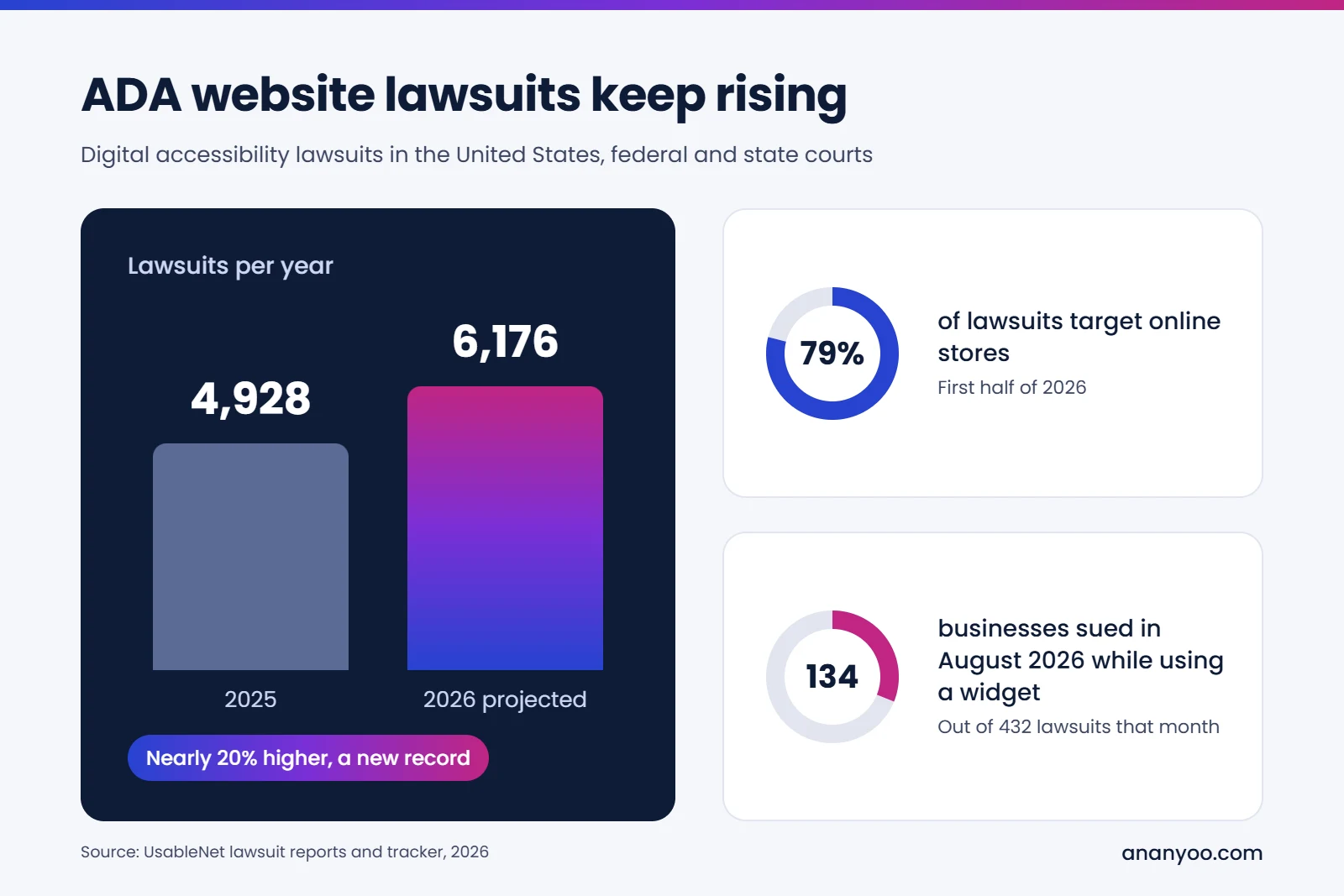
The numbers this year are the highest ever recorded. Based on filings up to mid-June, UsableNet projects about 6,176 digital accessibility lawsuits for 2026, a record and nearly 20% higher than 2025. The pace did not slow after midyear either. In August 2026 alone, 432 new ADA web accessibility lawsuits were filed, and 108 of those defendants had already been sued before.
Three patterns stand out in 2026:
- Online stores are the main target. About 80% of digital accessibility lawsuits involve e-commerce companies, with food service also taking a meaningful share.
- A small group drives most cases. Roughly 20 to 25 plaintiffs, working with a small number of law firms, bring most of these lawsuits.
- Letters far outnumber lawsuits. An estimated 35,000 to 50,000 demand letters were sent in 2025, and most of them never reach a court.
So if you received an ADA demand letter this year, your business was most likely found through an automated scan, not picked personally. That does not make the claim invalid, but it helps you respond calmly.
What to expect in 2027
There is no sign of this trend reversing. Here is what we expect US businesses and public bodies to face in 2027.
Private businesses (ADA Title III). There is no fixed deadline for private businesses, because the obligation already applies today. The DOJ's separate rulemaking for Title III is paused indefinitely, so courts will continue to decide cases using WCAG as the working benchmark. Letters and lawsuits will keep coming.
State and local governments (ADA Title II). In April 2026, the DOJ extended its web accessibility deadlines by one year. Public bodies serving 50,000 or more people must now meet WCAG 2.1 Level AA by 26 April 2027, and smaller entities and special district governments by 26 April 2028. The extension moves only the technical deadline, not the duty to be accessible, and complaints can still proceed before the compliance date arrives. Some legal experts read it as a warning that enforcement actions may begin once the April 2027 and 2028 deadlines arrive.
Courts are rewarding early fixes. Some judges now give defendants limited room to argue mootness, meaning the claim no longer applies because the business has already fixed the accessibility issues. This makes real remediation, done early and well documented, more valuable going into 2027.
What a typical ADA demand letter contains
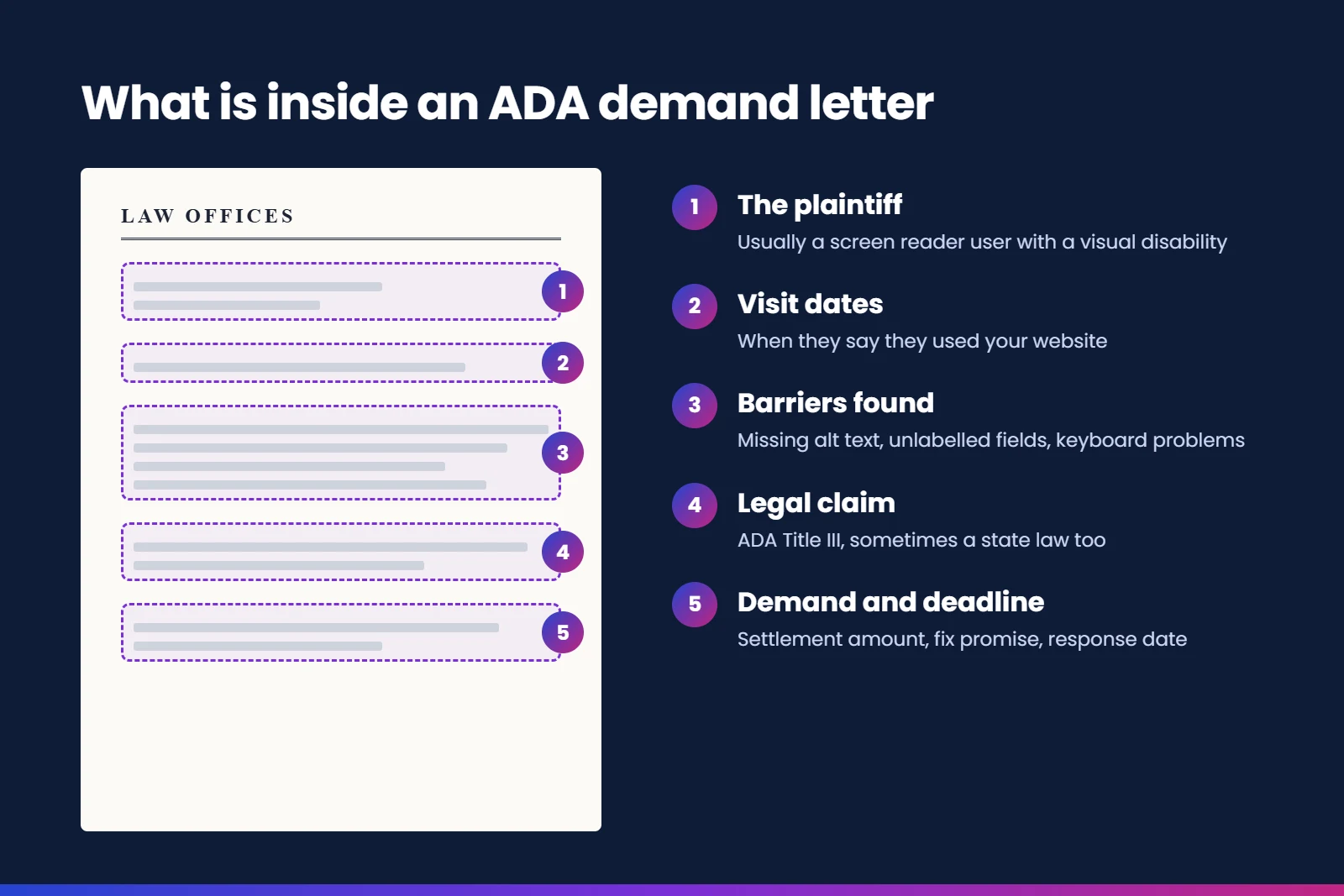
Almost every ADA demand letter follows the same pattern:
- The name of the plaintiff, usually a person with a visual disability who uses a screen reader
- The date or dates they say they visited your website
- A list of barriers, such as missing alt text, unlabelled form fields or a checkout that does not work with a keyboard
- A legal claim under the ADA, sometimes also under a state law
- A settlement demand, a promise to fix the website, and a deadline to respond
The 8 steps to take
1. Do not ignore the letter
Note the response deadline. Ignoring an ADA demand letter usually moves the matter towards a formal lawsuit, which costs far more in fees, settlement and time.
2. Do not pay in panic, speak to an attorney first
An ADA demand letter is a negotiation, not a court order. Share it with an attorney who handles ADA Title III matters before you reply or pay anything. We are accessibility auditors, not lawyers, and this post is not legal advice.
3. Check each claim in the letter
Go through every barrier listed in the ADA demand letter and check it on your website. Note the date the plaintiff says they visited. Some claims will be correct, some may be wrong or already fixed. These facts help your attorney.
4. Keep a record of your website as it is today
Save copies and dated screenshots of the affected pages before you change anything. Do not take the website down or hide pages to cover the problem.
5. Get an independent manual audit quickly
An automated scan finds only part of the problems. Serious barriers, like a keyboard trap in a popup or a form error that a screen reader never announces, can only be found by a human tester. You need a manual website accessibility audit against WCAG 2.1 or 2.2 Level AA, done with JAWS, NVDA and VoiceOver, plus keyboard-only and zoom testing. Our post on the most common WCAG violations found in audits shows what usually turns up.
6. Fix the code and document every fix
Most settlements that follow an ADA demand letter require you to fix the website anyway, usually within a fixed time. Fix issues in the source code, template by template, and keep a dated log of each issue, the fix and the re-test result. With courts now open to mootness arguments, this log can matter a lot. Our accessibility remediation work is built around exactly this kind of record.
7. Do not install a widget as your answer
A widget does not repair the code that screen readers read. In August 2026, 134 businesses were sued while a third-party accessibility widget was running on their site. We have explained this in detail in accessibility overlays: pros and cons explained.
8. Publish an accessibility statement and keep monitoring
Add an accessibility statement with a working email or phone number, so users can report problems to you before they report them to a lawyer. Then re-check the website regularly, because every new product, page or plugin update can bring new barriers. Our accessibility monitoring and maintenance plans cover this.
A simple readiness plan for 2027
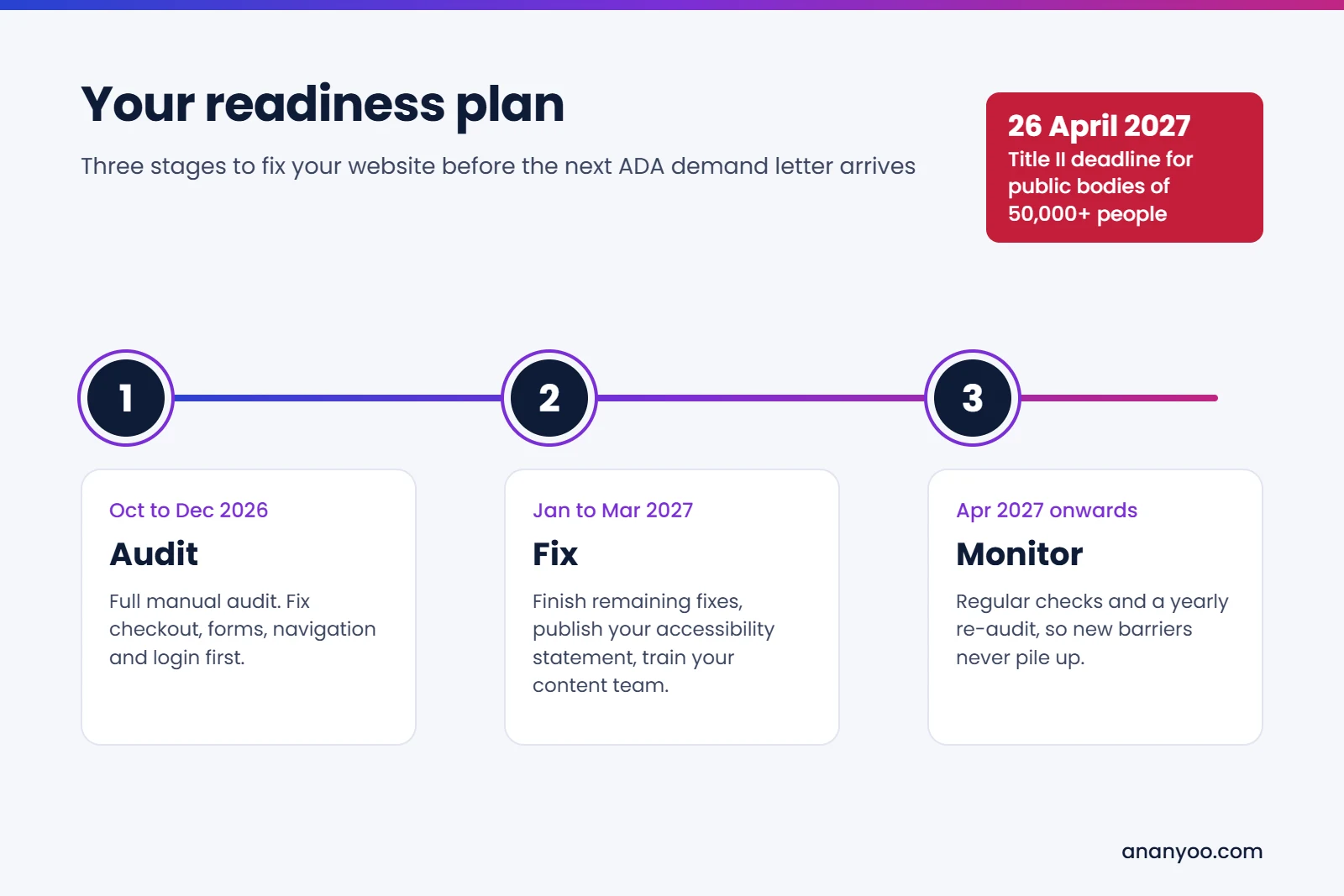
Even if you have not received an ADA demand letter yet, the last quarter of 2026 is the right time to act:
- October to December 2026: Get a full manual audit and fix the high-impact issues first, such as checkout, forms, navigation and login.
- January to March 2027: Complete the remaining fixes, publish your accessibility statement and train your content team on alt text, headings and link text.
- April 2027 onwards: Move to regular monitoring and a yearly re-audit. Public bodies serving 50,000 or more people must be fully ready by 26 April 2027.
How Ananyoo can help
I am Shivaji Mitra, a DHS Trusted Tester, working in web development and accessibility since 2003, and our audit team is IAAP certified. When you receive an ADA demand letter, we give you a fast written audit, a clear remediation plan and the actual code fixes, all documented in a form your attorney can use. See the details of our ADA demand letter response service.
For new builds and redesigns, we use our own accessibility-compliant accessible themes and accessible WordPress plugins, tested the same way we test client websites.
Send us your website address and a copy of the letter through our contact page, and you will get a written reply within one working day.
Frequently asked questions
Is there a deadline to fix my website after an ADA demand letter?
The letter itself gives a response deadline, often two to four weeks. Private businesses under Title III have no fixed legal date for compliance, because the obligation already applies now.
What are the current ADA Title II deadlines?
The current dates are 26 April 2027 for larger public bodies and 26 April 2028 for smaller ones and special districts.
Will fixing my website end the claim?
Not always, but it strengthens your position, and some courts now consider whether issues are already fixed.
Can I get another ADA demand letter after settling?
Yes. A settlement with one plaintiff does not stop another. Only a website kept accessible over time reduces this risk.
Leave a Reply