

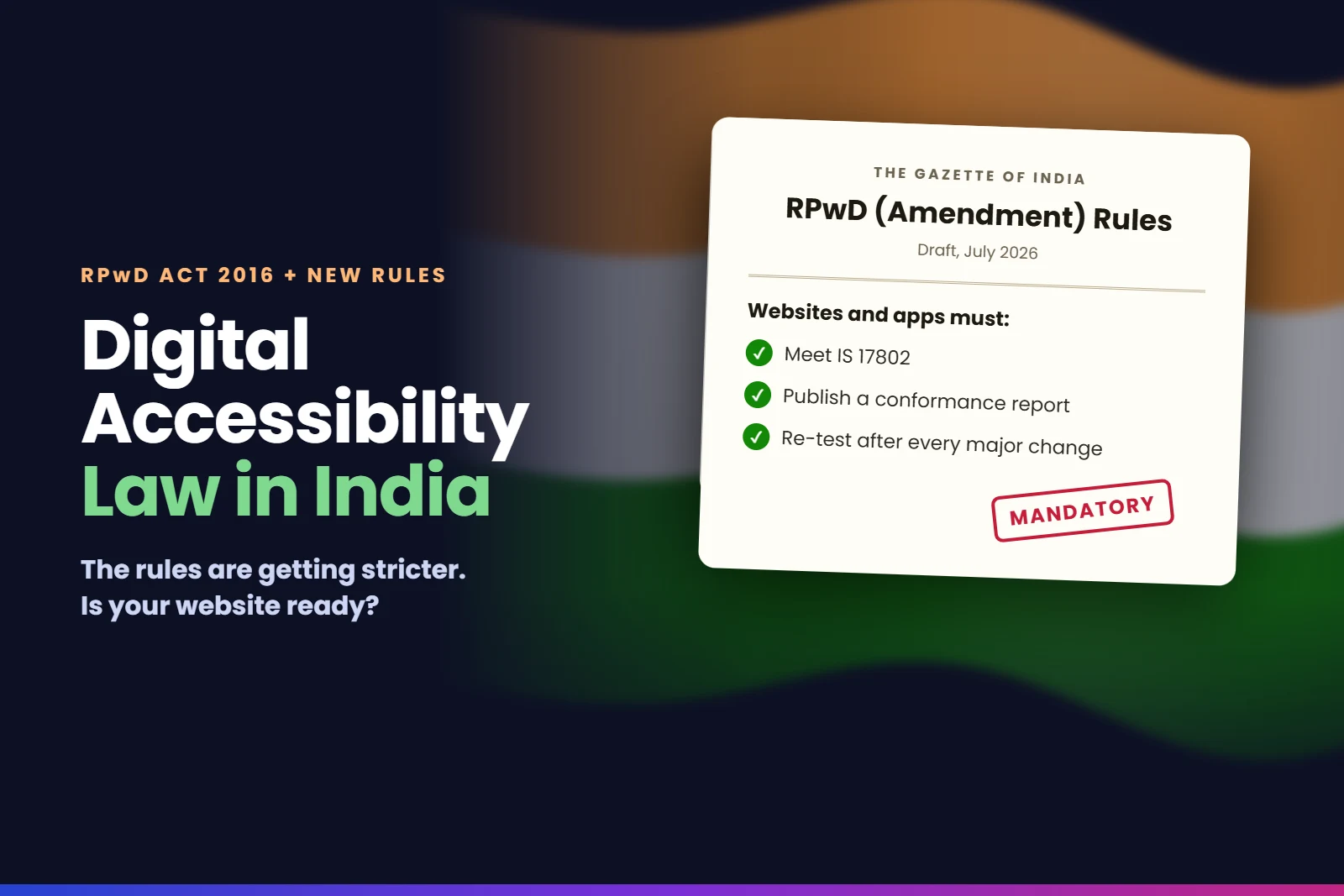
For years, the digital accessibility law in India looked strong on paper and weak in practice. The Rights of Persons with Disabilities Act said websites and apps must be accessible, but the rules under it used soft words, nobody checked, and most companies simply ignored it. That comfortable gap is now closing fast.
I have been building and testing accessible websites from Kolkata since 2003, for Indian and international clients. You can see some of that work in our web accessibility case studies. In this guide I explain, in simple words, what the law says today, what the new draft rules will change, who must comply, and what you should start doing now.
A quick note: this article explains the law for business owners and teams. It is not legal advice, and the 2026 rules discussed here are still in draft at the time of writing.
On this page
Why the digital accessibility law in India matters now
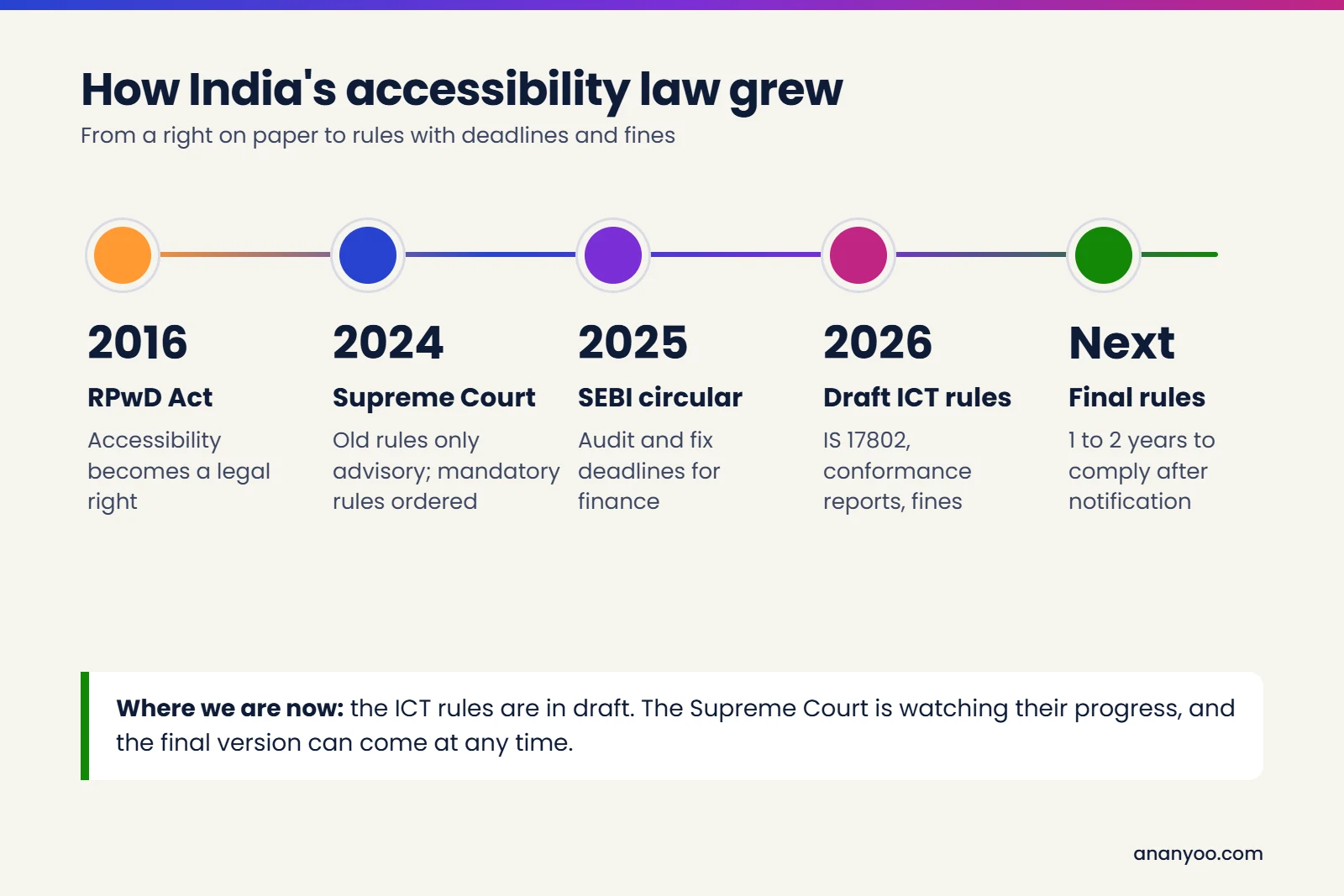
Three things happened in the last two years. First, in November 2024 the Supreme Court decided the Rajive Raturi case. It held that the old accessibility rules were only advisory, which went against the Act, and ordered the Government to frame mandatory rules.
Second, SEBI made accessibility compulsory for the whole securities market in 2025, with fixed audit and fix deadlines. Third, in July 2026 the Ministry of Social Justice and Empowerment published the draft RPwD (Amendment) Rules, 2026 for websites, apps, documents and other ICT products. Together, these turn the digital accessibility law in India from a promise into a duty with deadlines and fines.
The RPwD Act 2016 in simple words
The Rights of Persons with Disabilities Act, 2016 is the base of everything. You do not need to read all of it, but four sections matter for any website or app owner:
- Section 40: the Central Government must lay down accessibility standards, including for information and communication technology.
- Section 42: content in electronic media must be available in accessible formats, and everyday electronic goods must follow universal design.
- Section 46: service providers, both government and private, must provide their services as per these accessibility rules.
- Section 89: breaking the Act or its rules can attract a fine of up to Rs 10,000 the first time, and Rs 50,000 to Rs 5 lakh for later breaches.
The Act also uses the word "establishment" widely, so it is not limited to government offices. Our older article on disability rights in India covers the wider background of the Act.
What the draft 2026 rules require
The draft ICT rules, notified as S.O. 3962(E) on 16 July 2026, are the most detailed piece of the digital accessibility law in India so far. In short, they ask for the following.
One clear standard: IS 17802
Every website, mobile app, software, digital document and many ICT products must meet IS 17802, the Indian standard published by the Bureau of Indian Standards. Where a sectoral regulator like SEBI sets a stricter rule, the stricter one applies.
Who is covered
The draft covers every establishment, in India or abroad, that makes such products or services available to people in India. A foreign company with an Indian customer base is inside the scope too.
Deadlines based on turnover
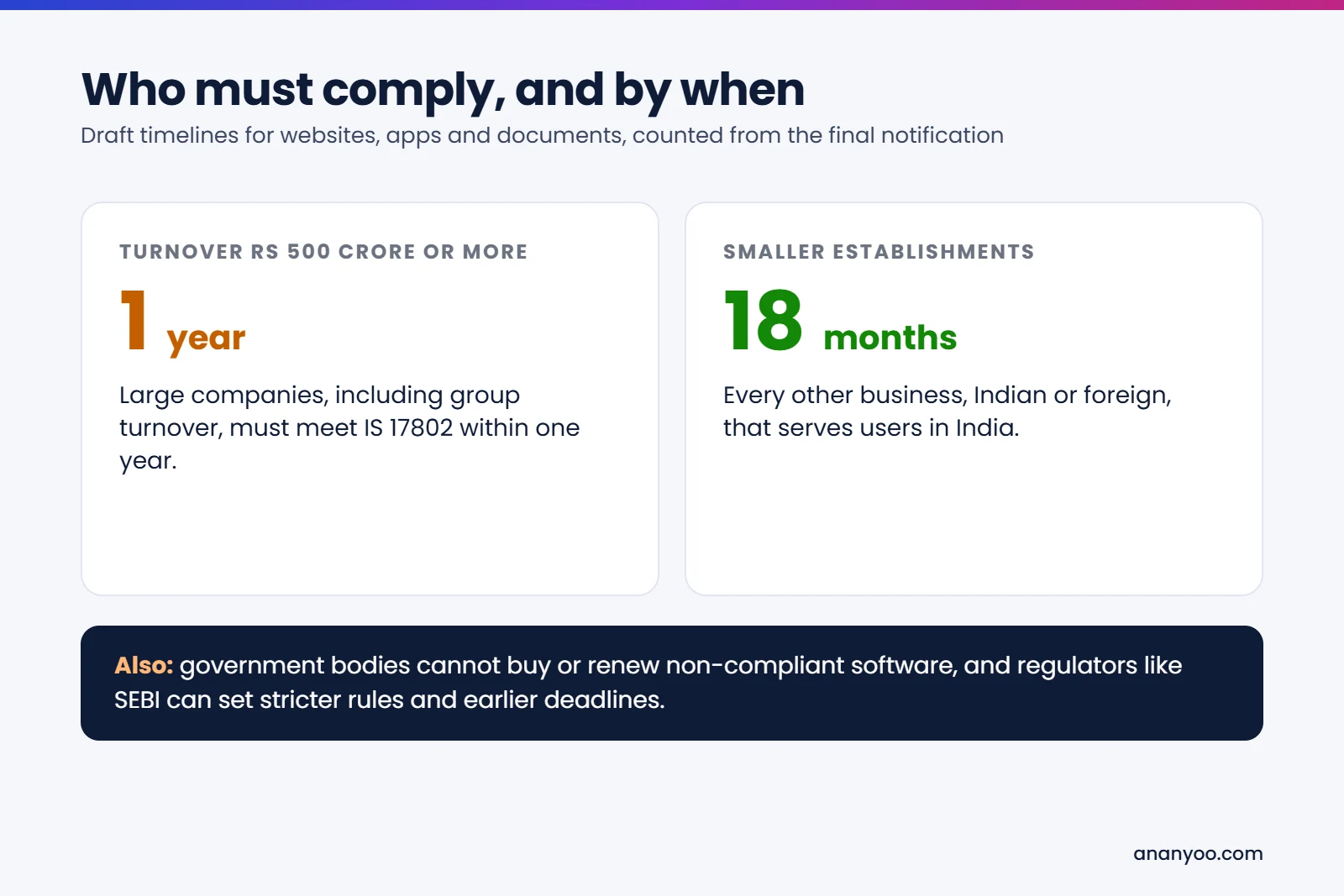
After the final rules are notified, establishments with a turnover of Rs 500 crore or more get one year, and smaller ones get eighteen months. Group turnover counts, so a small Indian arm of a large group is treated as large.
An Accessibility Conformance Report for everything
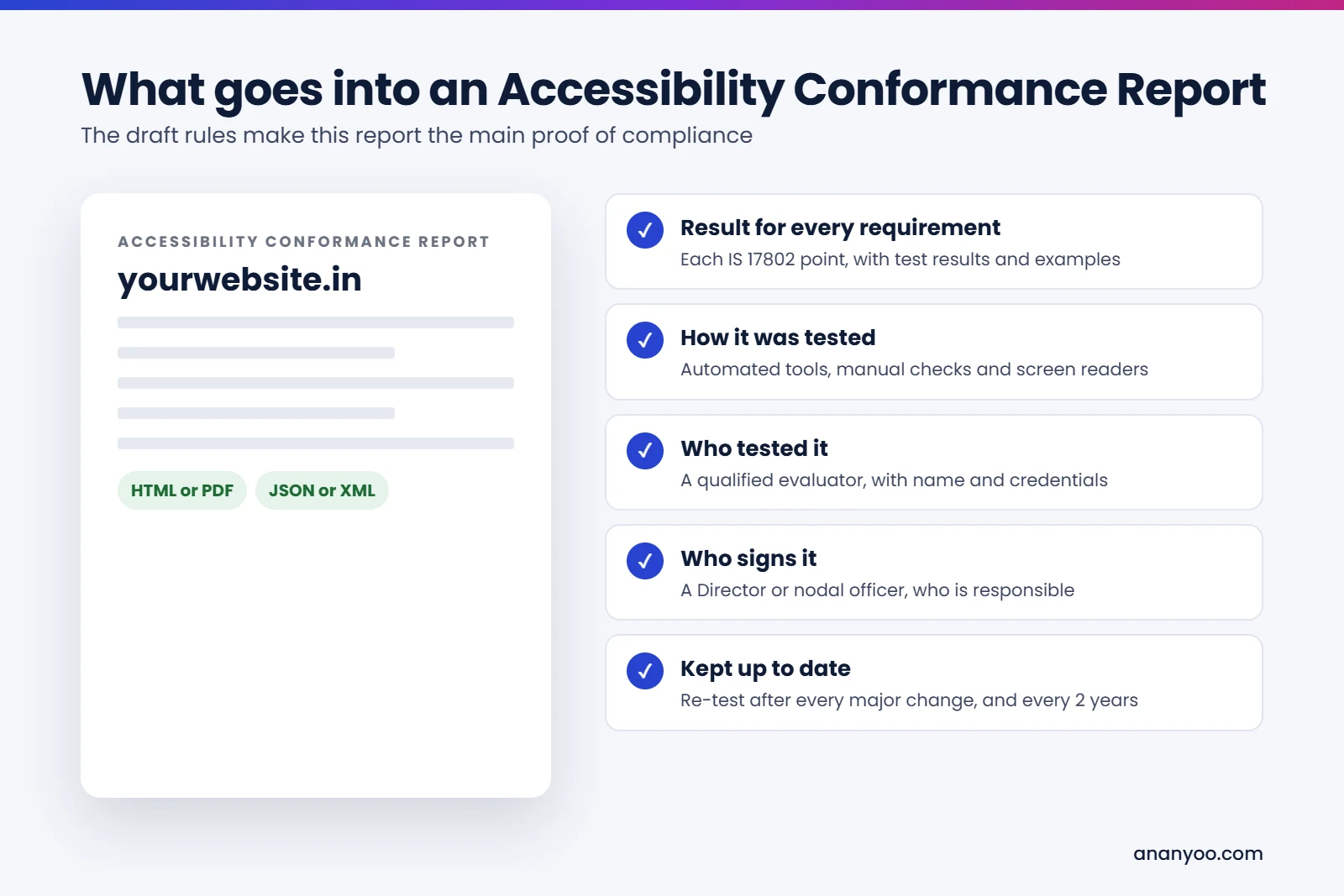
This is the biggest practical change. Every covered website, app or product needs an Accessibility Conformance Report, or ACR. It must be published free on your website or app, in a human readable format such as accessible HTML or PDF, and in a machine readable format such as JSON or XML.
The report must show the result for every requirement, explain how the testing was done, and name the qualified person or agency who did it. A Director-level officer or the nodal officer must sign it. It must be redone after every major change, and at least every two years. Copying a supplier's report without checking it does not protect you. In other words, under the new digital accessibility law in India, the report is not a formality. It is a public promise with a name and signature on it.
Grievances, penalties and procurement
Each establishment must name a Grievance Redressal Officer who answers complaints within thirty days, with appeals going to nodal officers in each ministry. Fines under Section 89 apply, regulators can add their own penalties, and continued failure can lead to suspension of a licence or registration. Government bodies may not buy, upgrade or renew any ICT product that does not comply. For software companies that sell to government, this is a serious commercial point: without a proper report, you may simply not be allowed to bid.
Does the law apply to private companies?
Yes. Many business owners still believe the digital accessibility law in India is only for government websites. That is not correct. Section 46 talks about service providers, whether public or private.
A well-known example is the complaint against Practo, the health app. The Chief Commissioner for Persons with Disabilities rejected Practo's argument that it was not bound by accessibility rules, and held that private IT service providers must make their services accessible. The draft 2026 rules make this even clearer by covering every establishment that serves users in India. So if you run an ecommerce store, a hospital portal, an edtech app, a travel booking site or a bank, the digital accessibility law in India applies to you.
SEBI and NSE: the finance sector is first in line
If you work in finance, you are already late. Through its July 2025 circular, SEBI made every regulated entity responsible for accessible websites, apps, KYC and investor documents, following IS 17802, GIGW and WCAG. After an extension, the audit deadline was 30 April 2026 and the remediation deadline was 31 July 2026. Many entities completed a quick automated scan and called it an audit. That is risky, because the exchanges now ask for both the audit report and proof that the findings were fixed.
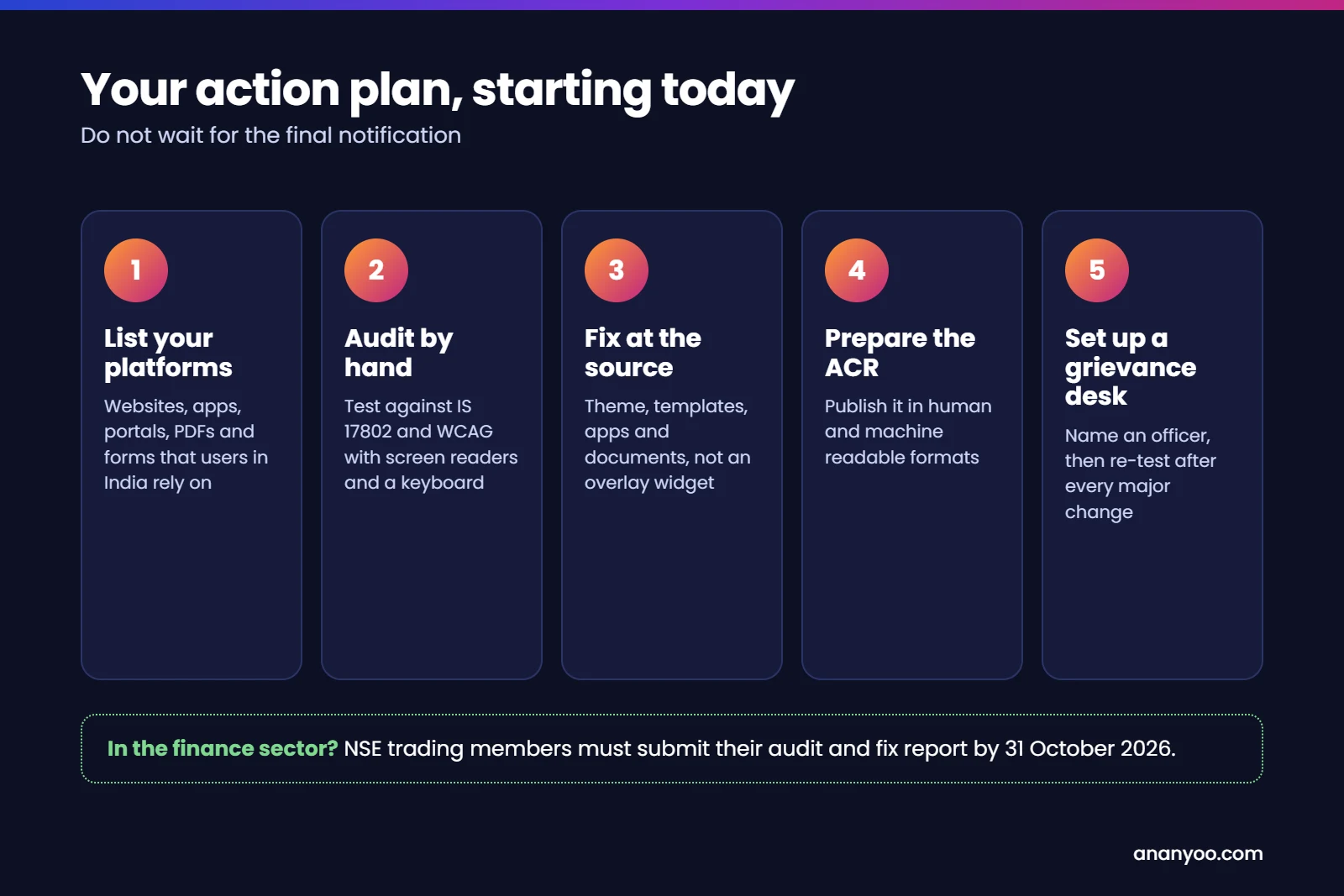
The exchanges are now collecting proof. In a September 2026 circular, NSE asked its trading members to submit their accessibility audit report and remediation details by 31 October 2026. Our SEBI accessibility compliance page explains how we help brokers, advisers and other regulated entities meet these dates.
IS 17802, GIGW and WCAG: how they fit together
People often get confused by the alphabet soup. Under the digital accessibility law in India, you will meet all three names. Here is the simple version:
- WCAG: the international Web Content Accessibility Guidelines from W3C. It is the base that most standards build on.
- IS 17802: the Indian standard for ICT accessibility, in line with the European standard EN 301 549, which itself includes WCAG for websites. Part 1 sets the requirements, Part 2 sets how to test them.
- GIGW: the Guidelines for Indian Government Websites, written for government sites but often referred to by regulators like SEBI.
In practice, a website that meets WCAG 2.1 or 2.2 Level AA covers most of what IS 17802 asks for websites. The extra work is in documents, apps, testing method and, now, the conformance report. If PDFs are a big part of your business, read our guide to document accessibility as well. Mobile apps also need separate testing, since a website report does not cover the Android or iOS app.
Common myths about accessibility law in India
"It only applies to government websites"
As explained above, private service providers are covered by Section 46, and the Practo decision confirmed it. The draft rules go further and cover every establishment serving users in India.
"Nobody enforces it"
That was mostly true before 2024. Now the Supreme Court is monitoring the rules, SEBI and the stock exchanges are collecting audit reports, and the draft rules add grievance officers, nodal officers and licence-level penalties. Enforcement of the digital accessibility law in India is clearly getting stronger.
"An accessibility widget will make us compliant"
Overlay widgets add a toolbar on top of the website but do not repair the code underneath. A conformance report must show real test results for every requirement, and a widget cannot produce that. We explain this in detail in accessibility overlays: pros and cons explained.
"We will start when the final rules come"
The timelines in the draft are short, and a proper audit, fix and report for a large site or app can take several months. Starting late usually means paying more for a rushed job.
Your action plan for digital accessibility compliance
Compliance with the digital accessibility law in India is easier when it is planned. The final rules can arrive at any time, and the clock starts on the day they are notified. Starting now gives you a calm project instead of a rush. This is the order we suggest:
- List your platforms: every website, app, portal, PDF and online form that users in India depend on.
- Audit by hand: test against IS 17802 and WCAG with screen readers like NVDA, JAWS and TalkBack, and with a keyboard. Automated tools alone find only part of the problems.
- Fix at the source: correct the theme, templates, apps and documents. An overlay widget does not fix the underlying code.
- Prepare the conformance report: write it honestly, publish it in both formats, and get it signed at Director level.
- Set up a grievance desk: name an officer, give an accessible way to complain, and re-test after every major change.
If you already have a VPAT for an international client, it is a good starting point, since the draft rules accept a VPAT-style format. Our VPAT and accessibility report page explains how we prepare one.
One more practical tip: keep a simple accessibility file for each platform. Put the audit report, the list of fixes with dates, the conformance report, and every complaint with its reply in one place. If a regulator, an exchange or the Commissioner ever asks questions under the digital accessibility law in India, you can show your whole history in minutes instead of searching through old emails.
Finally, train the people who add content every day. Most new barriers come from fresh banners without alt text, scanned PDFs and videos without captions, not from the original build. A short training session for your content and marketing teams keeps your website compliant long after the audit, which is exactly what the digital accessibility law in India now expects.
How Ananyoo can help
I am Shivaji Mitra, a DHS Trusted Tester, working in web development and accessibility since 2003. Our audit team is IAAP certified, which matters because the draft rules say the conformance report must be prepared by people with real accessibility credentials. For the digital accessibility law in India, we audit your website, app and documents by hand, fix the problems in the code, and prepare a conformance report you can publish and defend.
Read more about our website accessibility audit, accessibility remediation and monitoring and maintenance services. If you are in the finance sector, start with our SEBI accessibility compliance page. Or send your website address through our contact page, and you will get a written reply within one working day.
Frequently asked questions
Is website accessibility mandatory in India?
Yes. Under the digital accessibility law in India, the RPwD Act already requires it for government and private service providers, and the draft 2026 rules add a clear standard, deadlines and a conformance report.
Are the 2026 rules final?
Not yet. They were published as a draft in July 2026, and the Supreme Court has asked the Government to consider public suggestions before the final notification.
Does it apply to foreign companies?
Under the draft, yes. The digital accessibility law in India will cover any company, Indian or foreign, that makes websites, apps or ICT products available to people in India.
Is WCAG enough to comply?
WCAG 2.1 or 2.2 Level AA covers most website requirements, but IS 17802 also covers apps, documents and testing method, and the conformance report is a separate duty under the digital accessibility law in India.
